ECLAC: Sustainability as a Missing Principle in AI in Latin America and the Caribbean
Apr 23, 2026
Latin America and the Caribbean face a scenario in which AI is advancing amid significant structural inequalities: on the one hand, with critical infrastructure concentrated in a few countries and expanding; and on the other, with weaknesses in the incorporation of sustainability criteria, which poses significant challenges for the future development of the technology in the region.
This conclusion is drawn from the “Latin American Artificial Intelligence Index (ILIA) 2025”, produced under the auspices of the United Nations Economic Commission for Latin America and the Caribbean (ECLAC), which presents an assessment of the state of progress of artificial intelligence in 19 countries in Latin America and the Caribbean, with the aim of measuring, comparing, and guiding the development of their ecosystems. To this end, it constructs an index based on three dimensions—enabling factors, research, development, and adoption, and governance—using more than 100 sub-indicators, which allows for the identification of both progress and structural gaps in the region.
In this context, the report shows that digital infrastructure—including data centers and computing capacity—is a key component of AI development, but it is highly concentrated and unevenly distributed: only Brazil, Chile, Colombia, and Mexico have robust data center industries. Furthermore, Brazil accounts for more than 90% of high-performance computing capacity. Although there have been recent investments to expand this infrastructure, many countries still lack the capabilities to develop and deploy AI autonomously. Indeed, the lack of domestic infrastructure (advanced processors and local high-performance data centers) forces countries to rely on foreign cloud services, posing a challenge to technological sovereignty and to their ability to develop their own AI models. Thus, the document states:
“Greater access to GPU computing capacity, cloud services, and regional technology consortia can be an effective strategy to level the playing field and promote the development of artificial intelligence solutions. The region needs to expand and consolidate its AI infrastructure capabilities, with greater access to computing capacity, in order to improve its resilience for the development and deployment of AI through a fundamental enabling asset such as GPU capacity.”
ECLAC also emphasizes that, alongside this expansion, the issue of sustainability and environmental impact is emerging with force. In Latin America and the Caribbean, the growth of these centers poses a threat because many national electricity grids still rely on fossil fuels, which increases greenhouse gas emissions. A study cited in the report (Uptime Institute, 2024) reveals that only 35% of data centers in the region operate on 100% renewable energy. Uruguay stands out as a notable exception, with a 98% clean electricity grid. Furthermore, the report highlights the lack of information on AI’s energy consumption and carbon footprint, making it difficult to assess its actual impact.
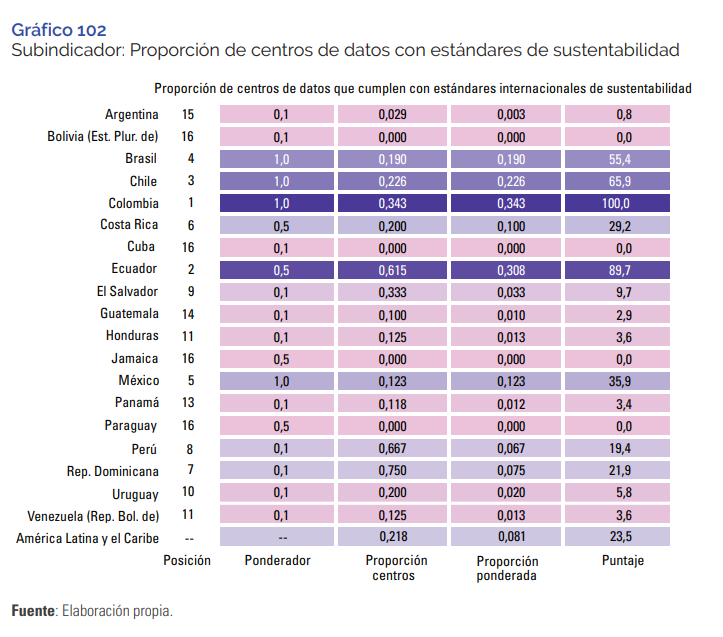
In the specific case of data centers in the region, the report indicates that only 20% (one in five) meet international sustainability standards (with certifications such as ISO 50001 for energy management or LEED for energy design), highlighting a significant gap between technological growth and adequate environmental practices. It is interesting to note that Colombia is identified as the country with the highest proportion of data centers meeting international sustainability standards relative to the maturity of its industry, unlike Chile, where the figure is less than 25%. In this context, the report identifies the lack of public data on certifications or efficiency as a central challenge, requiring regional collaboration to create a repository of sustainable data centers.
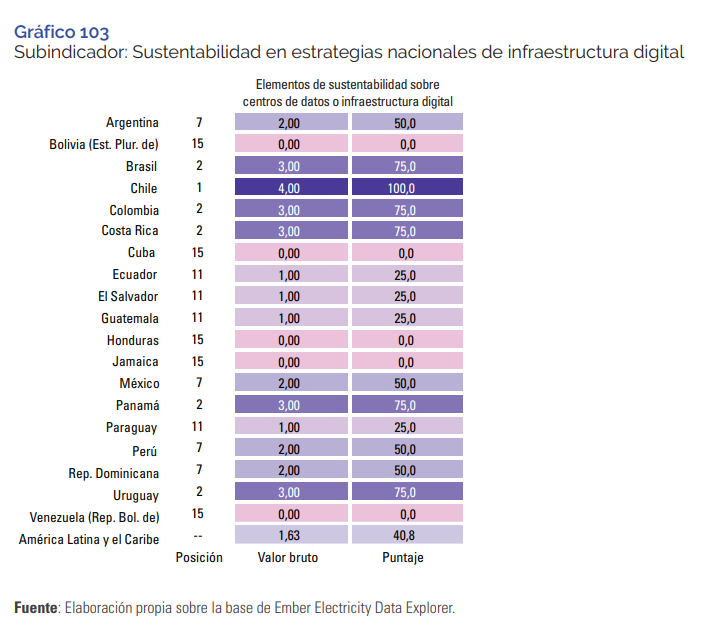
Likewise, the text highlights that sustainability is not meaningfully integrated into the AI and digital transformation policies of most countries (including national digital transformation plans, digital agendas, artificial intelligence strategies, data center infrastructure policies, and specific regulatory frameworks). This implies that the development of infrastructure and technological capabilities is proceeding without systematic consideration of their environmental, social, and economic impacts. In this regard, the report warns that, if these elements are not incorporated, the deployment of artificial intelligence could conflict with the region’s sustainable development goals. It is interesting to note that Chile has the highest score, due to the sustainability criteria of the National Data Center Plan, which has been criticized by local environmental groups, as we noted here.
Finally, ECLAC recommends a well-worn message: “the use of non-conventional renewable energy sources can be a first step toward leveraging countries’ capabilities for the deployment of clean and eco-friendly AI.” Needless to say, at DataCenterBoom! we do not view renewables at all as a miracle solution to AI’s ecological footprint unless they are combined with a series of other socio-environmental measures and principles of energy and climate justice.